It's been two weeks since I posted about learning about action research. I have decided on a question based upon not being in a classroom currently and reflecting upon weaknesses of my teaching CS. I felt I would love to learn more about teaching cybersecurity. I don't have enough knowledge to do this well, and I always fumble. I also think that students need to understand the fields that can be involved in cybersecurity and that it is not just about hacking. When I have students complete GoCyberStart, I know I am no help. I have even struggled to complete them. I need to get better at this, now is the time.
My research question is:
My research question is:
How do I design an inquiry-based unit on cybersecurity for students to understand the impacts on their lives?
This will provide me with a chance to determine what is essential for students to know about cybersecurity, learn more about cybersecurity, and an opportunity for action research as a teacher who is not in the classroom right now.
I have begun to look at journals and determine what information is already there. I have found some college courses created for general education, social media surveys of middle schoolers, and some summer camp curricula. The information has been interesting to see how others have done action research since that is most of what I read. Many utilized surveys pre and post to determine the effectiveness of the classes. I have been struggling with collecting data when I am not with students. ARGH. Challenge.
Chapter 5 of The Reflective Educator's Guide to Classroom Research by Dana and Yendol- Hoppey (2020), discusses data and developing a research plan. They provide 10 different strategies for data collection, from field notes and journalling to surveys and student artifacts. After reading this chapter, I designed the following table about data and items I need to answer my question. (these are not in any particular order)
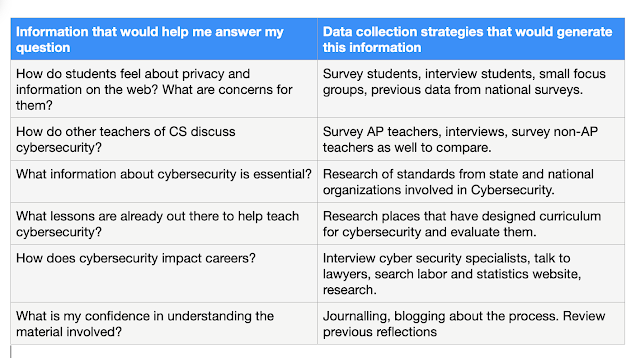
I would love more comments on anything else that might be beneficial to me during this action research. Thanks!
Reference:
Dana, N. F., & Yendol-Hoppey, D. (2020). The reflective educator’s guide to classroom research: Learning to teach and teaching to learn through practitioner inquiry (4th ed.). Corwin.
Dana, N. F., & Yendol-Hoppey, D. (2020). The reflective educator’s guide to classroom research: Learning to teach and teaching to learn through practitioner inquiry (4th ed.). Corwin.
Comments
Post a Comment